AI brand and product design system
GIA Studio
Creating a Shared Product Language for Enterprise AI
- Period
- 2025
- Role
- Concept, Brand Identity and Product Design System
- Context
- GBM
- Platform
- Enterprise AI product experiences
- Collaboration
- Scrum Master, Design, internal client and Development
- Artifact status
- Original Figma prototypes and an evolving internal product
Case summary
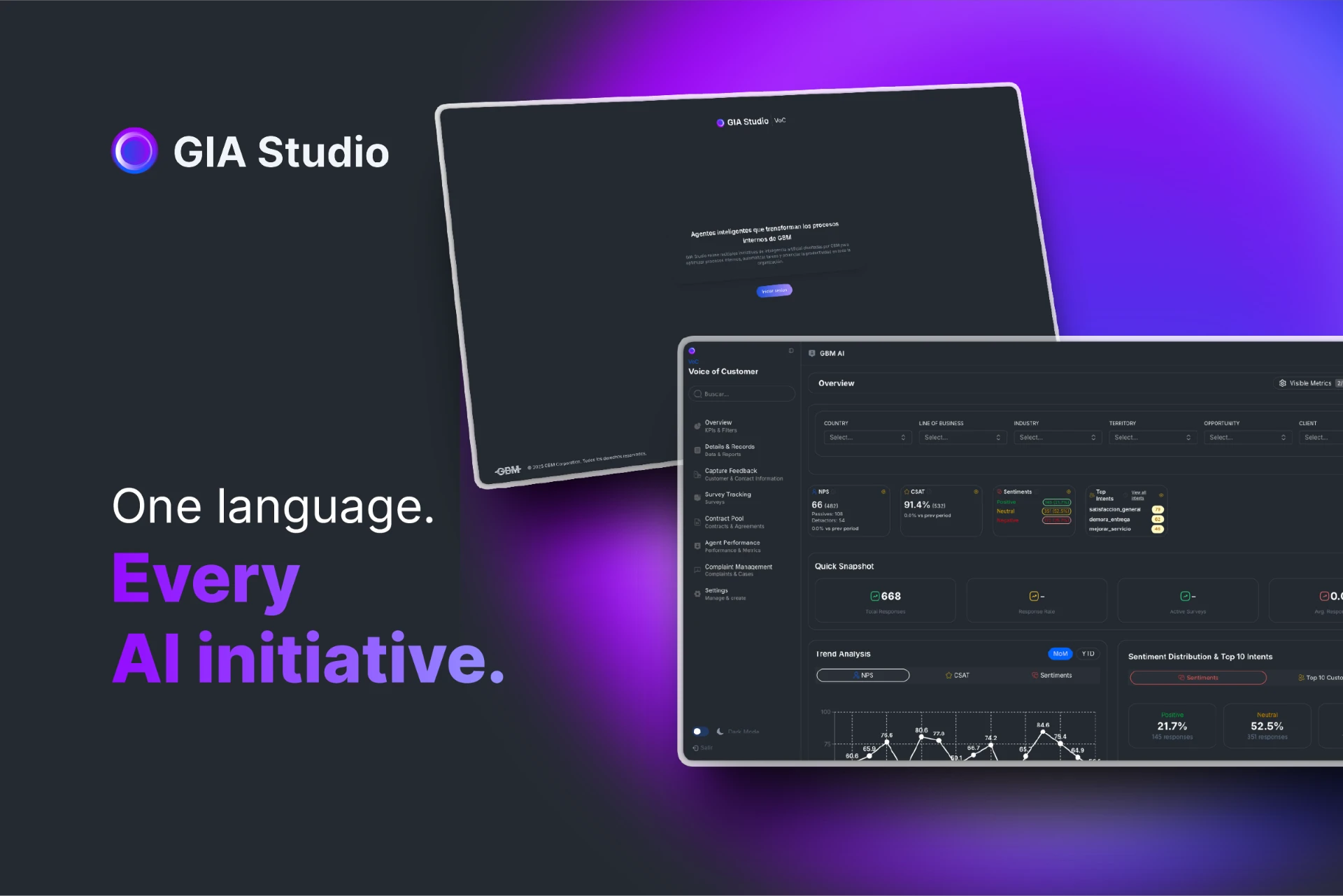
GIA Studio began with a request to design interfaces for a growing set of internal AI initiatives at GBM. I saw an opportunity to go further: instead of allowing each solution to develop its own visual language, I created a shared concept, identity and product design system that could unify how these experiences were designed and developed.
I designed the original Figma prototypes and screens. Voice of Customer has continued to evolve while retaining much of that work, with team adaptations for additional requirements.
The idea behind GIA
The name combines G, for GBM, with IA, the Spanish abbreviation for Inteligencia Artificial.
My vision was for GIA Studio to provide a recognizable frame for GBM's AI initiatives: not only a logo applied to individual products, but a connected system spanning identity, components, patterns, prototypes and interfaces.
Expanding the brief
The Data & AI team initially requested interface design. As more internal AI initiatives emerged, designing each one independently risked creating fragmented experiences and repeated work.
I proposed a broader foundation: one concept and one product language capable of supporting multiple solutions without reinventing the interface for each project.
Designing a brand that could expand with the portfolio
The identity was designed as an extensible architecture rather than a single fixed logo. GIA Studio acted as the master concept, while each capability or initiative could be identified through a consistent lockup: GIA Studio | Initiative.
The component system included variations for names such as Agentes, Asistente Virtual, CoE, PMO, VoC, L1, IDQR and IPAAS, with both prominent and compact configurations.
A shared foundation for AI solutions
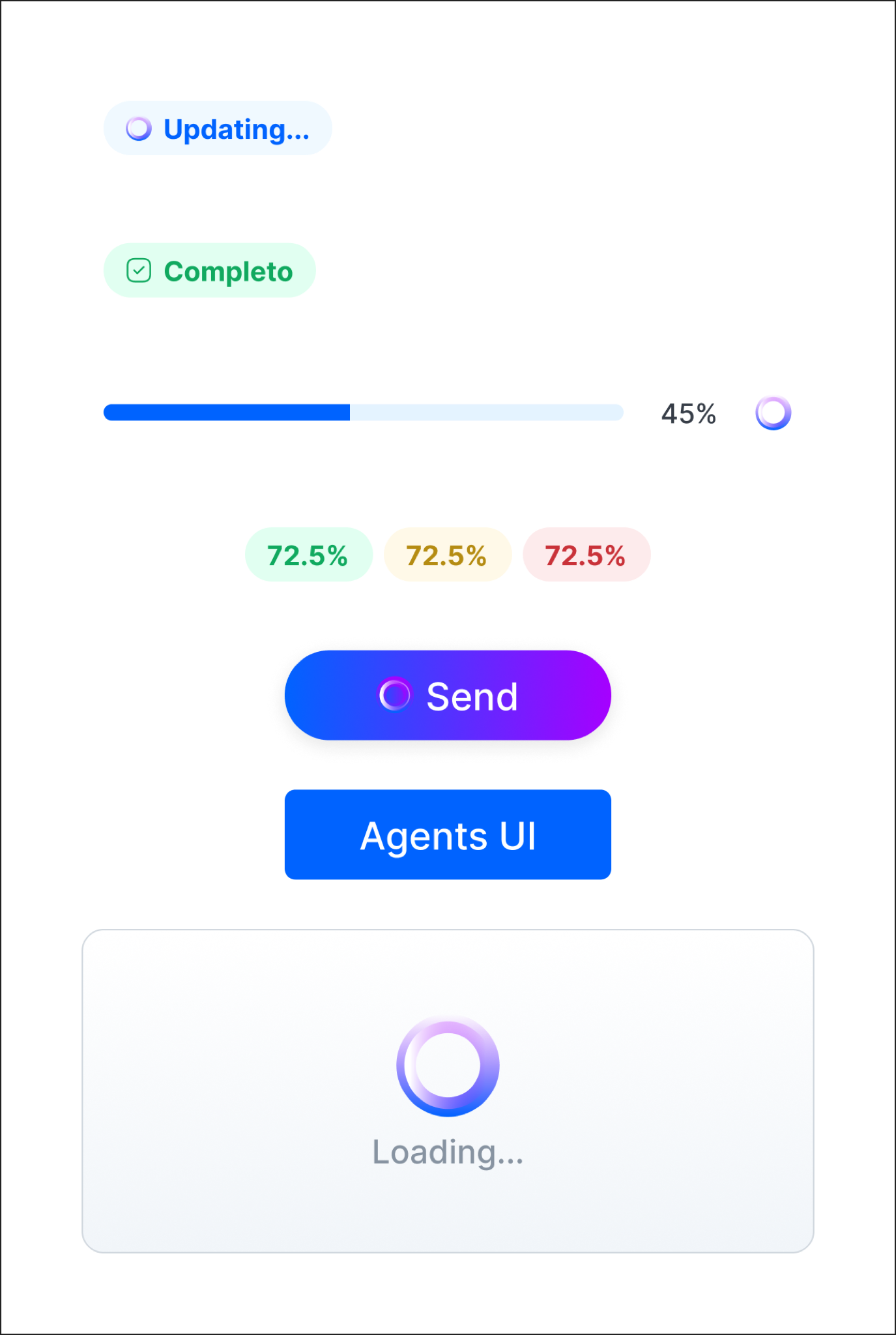
The design system established a unified base instead of inventing a different design language for each solution. Components, patterns and screens could share the same visual and interaction logic across prototypes with very different purposes.
The work was coordinated through a Scrum Master who brought together the internal client, Design and the Development team. I designed all the Figma work shown in this case, and the system was presented and used as a shared design system.

Application example — AI Assistant for L1
AI Assistant for L1 shows how the GIA Studio language could operate across a complete product experience rather than an isolated screen: a landing page introducing a portfolio of internal AI agents, sign-in and registration flows, an agent catalogue, a conversational workspace for technical-support interactions and an operational dashboard for unanswered-question topics.
The screen copy describes the assistant as supporting first- and second-level technical work by improving access to manuals and articles and providing monitoring capabilities. The prototype communicates that intended experience; it is not presented as production UI.
GIA Studio landing → authentication → agent catalogue → AI Assistant for L1 → chat / operational dashboard
Application example — AI Extracción de Procesos
The PMO application reuses the GIA Studio landing page, authentication and agent catalogue, then shifts into a specialized operational workspace for managing document-processing executions: project navigation, an execution table, clear execution states and progress, search and creation actions and downloadable Excel outputs.
The catalogue describes the intended product as analyzing documents, identifying relevant business information and transforming the extracted content into a standardized Excel format.
Project navigation → execution table → status / progress → export or create execution
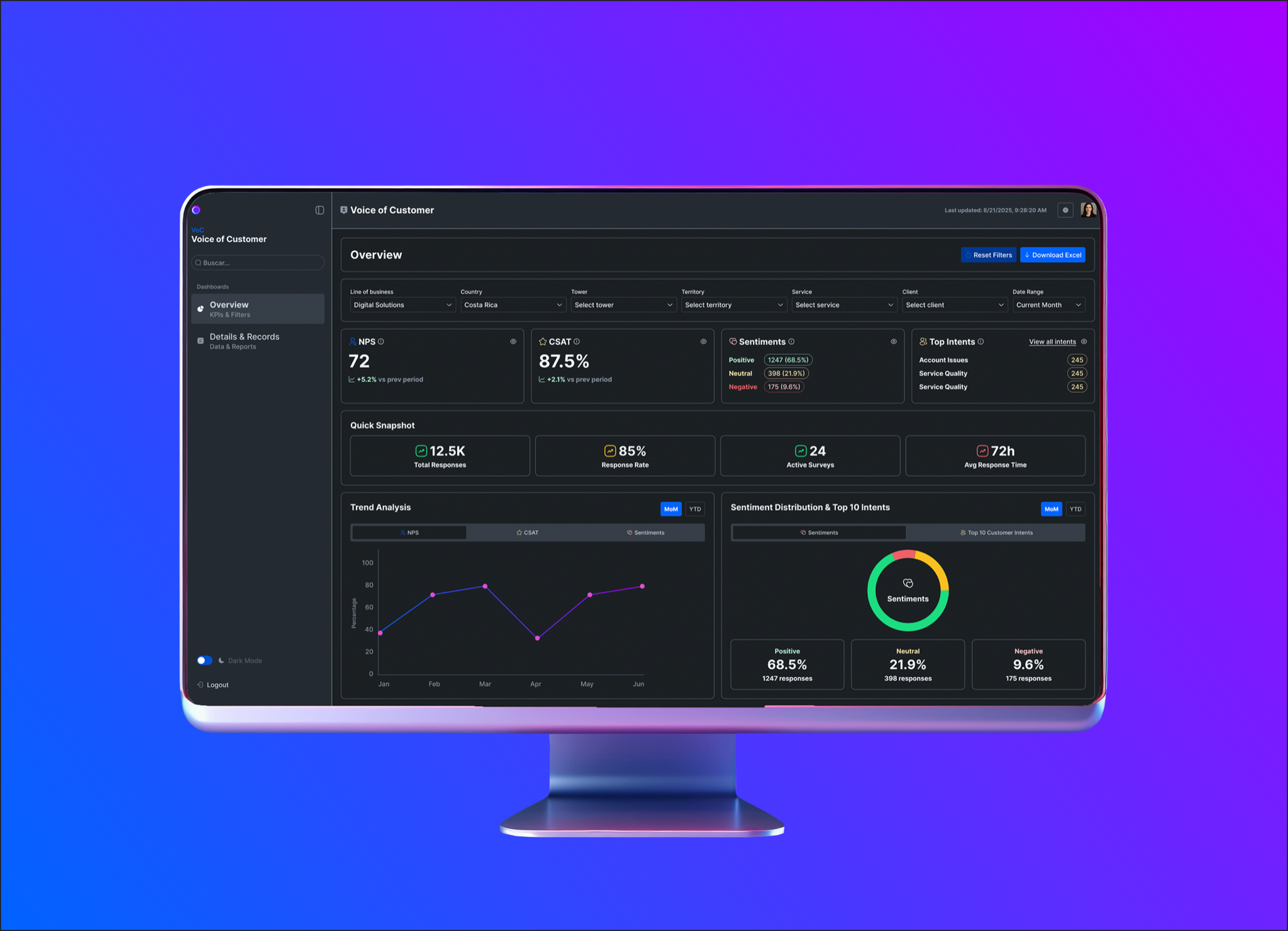
Voice of Customer — From feedback to operational follow-up
VoC was conceived to bring together customer feedback collected across different tools and consolidated manually. The challenge was not only to show experience indicators, but to connect them with the records, responsibilities and follow-up tasks behind them.
I designed the interfaces and interaction patterns for consulting indicators, exploring detailed records, configuring metrics and managing survey follow-up. KPI cards, charts, multidimensional filters, tables, workflow states and agent-performance views gave those tasks a shared product language.
The product has evolved while retaining much of my prototype and screen design work, with adaptations by the team for additional requirements. The reviewed evolution connects feedback capture, analysis, survey operations and complaint follow-up, including assigned responsibilities, action plans, review and closure.
My contribution goes beyond a visual foundation: the designs organize how people move between a summary, its supporting detail and operational tasks. Filters and the agent interaction remain under review.
The reviewed evolution is in an internal test environment.
Platform concept — Agents
Agents broadens the GIA Studio story from reusable interface patterns to a proposed shared environment for accessing AI agents through one interface. Its documented workspace combines a conversational surface with a reasoning surface where the agent's sequence appears as individual nodes with execution states.
The navigation includes creation, dashboards, owned agents, integrations, analytics, components, governance, configuration and help.
Application example — IDQR
IDQR — ITSM Documentation Quality Review demonstrates a configurable quality-evaluation system rather than a fixed dashboard. Evaluation Management defines the criteria and instructions, Evaluation Details applies criterion-level scores to individual ITSM tickets, and the dashboard aggregates results into regional scores, country comparisons, maps and monthly trends.
Define criteria → evaluate documentation → inspect records → compare performance → identify opportunities for improvement
Production context and documented value
The prototypes belong to a broader CoE Data & AI portfolio with separately documented operational outcomes.
- Agent L1: consultation time reduced from 15–20 minutes to 1–2 minutes, with fewer L2/L3 escalations.
- PMO: document processing reduced from 3–5 days to 10–30 minutes, 20–30% more obligations captured and more than 50 documents processed.
- IDQR: up to 80% less audit time, no manual ticket reading and coverage expanded from sampling to 100%.
- Electronic Invoicing: 80% automatic processing, with automated validation, registration and purchase-book handling.
From Client Zero to a broader product vision
The larger idea behind GIA Studio was to use GBM's internal experience as Client Zero: build in-house projects to test AI capabilities first, then use what had been learned and proven internally as the basis for services and products that could be offered commercially under a recognizable brand.
That wider brand vision was not fully adopted. The identity, design system and prototype language were created and applied, but GIA Studio did not become the official overarching AI brand I had envisioned.
What this project changed in my practice
GIA Studio reinforced that consistency is not only a visual concern. When several products are being developed under the same organization, identity, reusable components and shared interaction patterns can help them behave like a portfolio rather than unrelated experiments.
It also represents how I approach ambiguous briefs: I can deliver the requested interface while identifying the larger product and brand system that the organization may need next.
Visuals in this case include: Placeholder · Prototype.